Understanding Participating Preferred Stock Benefits
Discover the benefits of participating preferred stock, where investors enjoy priority payments and shared proceeds. Learn how it differs from non-participating types and evaluate investment options with our practical guide.
YieldDesk7 min readPublished
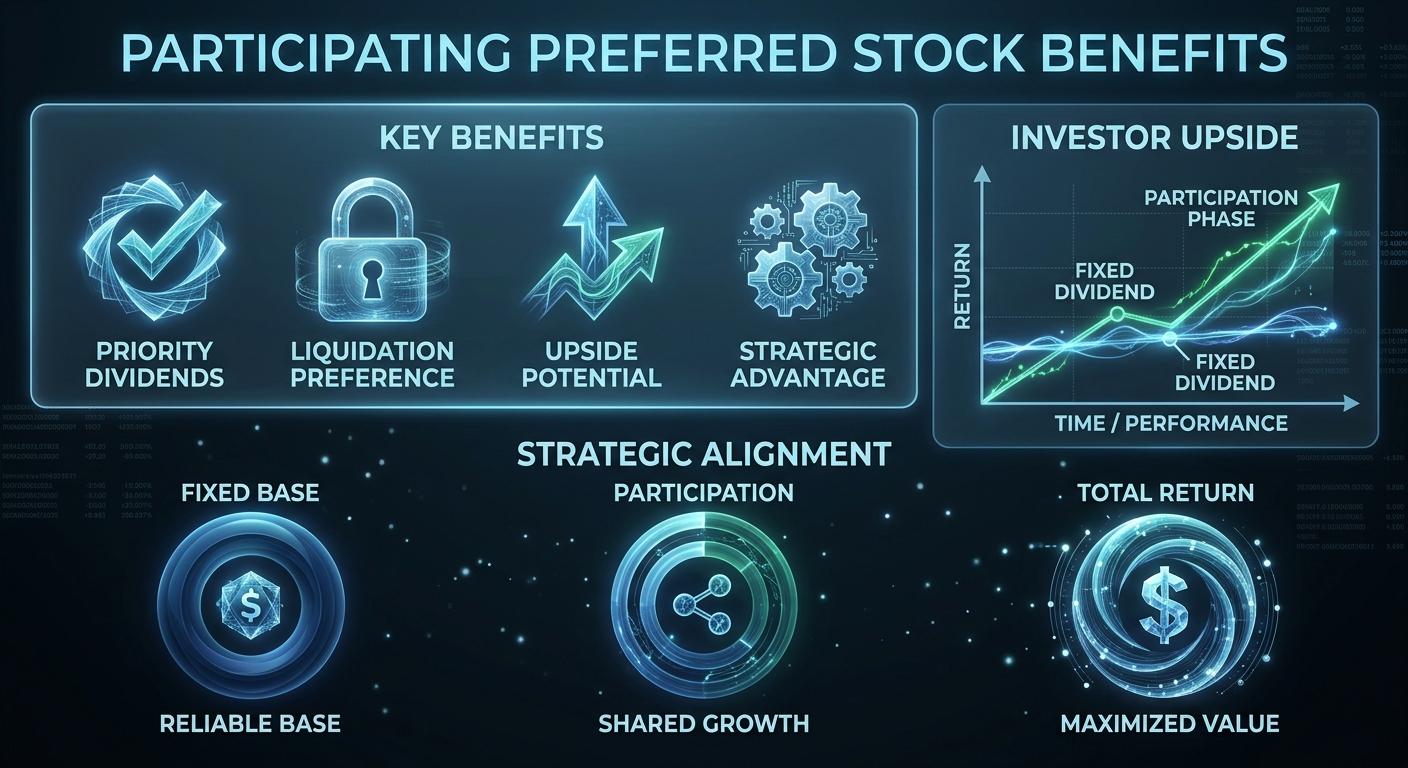
Participating preferred stock combines priority over common shareholders with the opportunity to share in additional distributions. Depending on the terms, that participation can apply to dividends, proceeds from a company sale or liquidation, or both. Understanding these rights helps investors and founders evaluate the benefits of preferred equity without mistaking payment priority for guaranteed returns.
What is participating preferred stock?
Participating preferred stock is a class of preferred shares that gives holders a stated preference plus contractual rights to share in further distributions alongside common shareholders. In venture financing, this generally means receiving a liquidation preference first and then a proportional share of the remaining exit proceeds. Dividend participation is a separate feature that must also be established by the share terms.
The key distinction is between priority and participation. Priority determines who receives a distribution first. Participation determines whether preferred holders also share in what remains after the applicable preferences have been satisfied.
Preferred equity remains an ownership interest, not a promise that an investor will recover their money. Creditors generally rank ahead of shareholders, and insufficient assets can leave preferred investors with losses despite their seniority over common stock.
The benefits: priority, additional upside, and negotiated rights
The attraction is straightforward: investors can retain a preferred position while benefiting from distributions beyond that preference. However, each benefit depends on the governing documents rather than the security’s name alone. The SEC identifies liquidation preferences, dividend rights, and certain voting protections among the rights that preferred stock may carry.
Priority before common shareholders
A liquidation preference gives investors a claim on available proceeds before common shareholders receive distributions. A 1x preference, for example, generally refers to one times the original investment, subject to the applicable terms and available funds. This can improve an investor’s recovery in a disappointing exit, but it does not place them ahead of creditors or guarantee full repayment.
Participation beyond the initial preference
Participation can increase an investor’s payout when enough proceeds remain after preferred claims are paid. Rather than stopping at the preference amount, holders also receive their agreed share of the remainder. This additional allocation comes from proceeds that would otherwise be available to common shareholders, making it a meaningful negotiation point for founders and employees.
Rights beyond the payout formula
Preferred shares may also include approval rights over major transactions or rights to elect designated directors. These shareholder rights are distinct from participation: an enhanced economic payout does not automatically confer greater control. Review governance provisions separately from dividend and liquidation provisions when comparing investment options.
How do participating and nonparticipating preferred stock differ?
Participating and nonparticipating preferred stock differ primarily in whether investors can receive both their liquidation preference and a share of the remaining proceeds. With convertible non-participating preferred stock, investors generally receive either the preference or the amount available through conversion to common stock—not both. Participating preferred allows the preference plus further participation, subject to any cap.
For a practical participating vs. non-participating preferred stock comparison, consider these mechanics:
Feature | Participating preferred | Non-participating preferred |
|---|---|---|
Initial priority | Receives its contractual liquidation preference | Receives its contractual liquidation preference if not converted |
Remaining proceeds | Shares alongside common holders under the participation formula | Does not share while retaining the preference |
Conversion decision | May matter when participation is capped | Generally compares preference with the as-converted payout |
Common shareholder allocation | Reduced by the additional participation payment | Remaining proceeds go to common holders when preferred takes its preference |
These are simplified exit mechanics, not universal terms for every preferred security. Conversion rights, seniority, and participation limits must be checked in the actual documents.
A worked example of sale proceeds
Suppose an investor contributes $2 million for preferred stock representing 20% ownership on an as-converted basis, meaning the ownership percentage if converted into common shares. Assume a 1x liquidation preference, no accrued dividends, no other preferred classes, and $10 million available for distribution to shareholders after debt and transaction costs.
With uncapped participating preferred stock, the hypothetical distribution works like this:
Pay the preference: The investor receives $2 million first.
Calculate the remainder: $10 million minus $2 million leaves $8 million.
Apply participation: The investor receives 20% of $8 million, or $1.6 million.
Total the payments: The investor receives $3.6 million, and common shareholders receive $6.4 million.
Under otherwise identical non-participating terms, the investor would compare a $2 million preference with 20% of the full $10 million through conversion. Both alternatives equal $2 million, leaving $8 million for the other shareholders.
The participation provision therefore shifts $1.6 million to the preferred investor in this illustration. It does not create additional company value; it changes how the available value is divided.

Treat this as a teaching example, not a forecast. A real transaction requires a distribution model that accounts for every relevant share class, preference, and conversion provision.
Dividend participation is a separate benefit
Participation can also concern dividends rather than—or in addition to—sale proceeds. Some preferred shares allow holders to receive additional dividends alongside common shareholders under a specified formula. That formula must be read separately from the liquidation clause; rights at an exit do not establish an identical right to ongoing distributions.
For dividend analysis, distinguish three questions:
Preference: What dividend entitlement applies before distributions to common shareholders?
Participation: Does the holder share in additional dividends, and how is that amount calculated?
Accumulation: Do unpaid dividends accrue, or are they noncumulative?
Also distinguish dividends paid on stock from stock dividends, which are distributions of additional shares rather than cash. Participation does not necessarily mean a cash payment or a larger number of shares; the payment form and entitlement depend on the terms. Declaring dividends may also require board action and legally available funds.
Caps and conversion can change the outcome
A participation cap limits the total payout available under the preferred participation formula. For example, a hypothetical 2x cap on a $2 million investment could limit preference-plus-participation payments to $4 million. Check whether the cap includes the initial preference and how dividends are treated.
A cap does not necessarily impose an absolute ceiling on what the investor can receive. If conversion rights permit, the holder may instead convert to common stock when that produces a larger payout. Model both routes rather than assuming the cap settles the final distribution.
A practical checklist before evaluating preferred equity
Before deciding whether participation is attractive, translate the documents into a payout model. In corporate finance, a headline ownership percentage alone does not explain how exit proceeds will be allocated. Preferences, conversion rights, and seniority can materially change the result.
Use this checklist to focus the review:
Identify the trigger. Determine whether the rights apply to dividends, liquidation, a company sale, or specified deemed liquidation events.
Confirm the preference. Record the investment base, preference multiple, and treatment of unpaid dividends.
Map seniority. Establish which preferred classes get paid first and which share the same rank.
Define participation. Confirm the as-converted percentage and any participation cap.
Check conversion. Compare keeping the preference with converting to common stock across different exit values.
Review governance separately. Identify approval, voting, and board-election rights rather than inferring them from economic participation.
For private-company shares, also investigate resale restrictions and likely liquidity. An attractive contractual payout is not the same as an investment that can be sold when needed.
The takeaway: evaluate the payout, not just the label
Participating preferred stock can provide payment priority plus additional upside, but those benefits depend on the precise terms. Compare the preference, participation formula, cap, conversion rights, and dividend provisions together. The most useful next step is to model several outcomes and have qualified advisers review the documents before committing capital or accepting financing terms.
FAQs
1. What is the primary advantage of participating preferred stock?
The primary advantage of participating preferred stock is that it combines a liquidation preference with the ability to share in additional distributions alongside common shareholders, potentially increasing the total payout in favorable exit scenarios.
2. How does participating preferred stock differ from regular preferred stock?
Participating preferred stock allows investors to receive both their liquidation preference and additional amounts from company proceeds, while regular preferred stock typically does not offer such participation in extra distributions.
3. What are the potential downsides of participating preferred stock?
The downsides may include complexity in terms of payout calculations and potential caps on participation, which can limit total returns. Additionally, preferences do not guarantee returns if the company performs poorly or has insufficient assets.
4. Can dividend rights also be part of participating preferred stock?
Yes, participating preferred stock can allow holders to receive additional dividends alongside common shareholders, provided the terms specify such participation.
5. What factors should an investor consider when evaluating participating preferred stock?
Investors should consider factors such as liquidation preferences, participation terms, caps on payouts, conversion rights, and the specific governance rights conferred by the preferred shares.
Library articles are general information about securities and markets. They are not advice on any security or on whether to buy or sell it. Disclosures
The preferred stocks list shows every public record with its price, coupon, call date and yield.
The preferred stocks listRelated articles



One issue, every Sunday.
Eight blocks of data, one chart, no commentary. Rates, the week's movers, listings and filings across preferred stocks, BDCs and covered-call ETFs.
Free · Sundays · unsubscribe at any time · addresses are never shared