Covered Call ETF Guide: Income, Yields, Taxes and Risks
Learn how a covered call ETF earns monthly income, how Nasdaq-100, bank and bond funds differ, how payouts are taxed, and which risks remain.
YieldDesk11 min readPublished
Key takeaways
How does a covered call ETF generate income?
How do Nasdaq-100, bank and bond covered call ETFs compare?
QYLD and QYLG: Nasdaq-100 covered call ETFs
ZWB: Canadian banks
TLTW: Treasury bonds
What does a high covered call ETF distribution rate actually measure?
Example: $50,000 in a fund with a 12% distribution rate
What risks do monthly payments not remove?
How are covered call ETF distributions taxed?
How do you choose a covered call ETF? A practical checklist
FAQs
What is a high dividend covered call ETF?
How do covered call ETFs make monthly income?
Is covered call ETF income the same as dividend yield?
Why can a covered call ETF's share price fall while it pays monthly?
Are covered call ETF distributions return of capital?
Conclusion
A covered call ETF pays monthly cash by selling call options against the stocks or bonds it holds. The fund trades some upside for that premium income, but the payment can change from month to month, and the share price can still fall. This guide covers how the income works, how Nasdaq-100, bank and bond funds differ, what a distribution rate measures, how the payments are taxed, and what to check before you buy.
YieldDesk is a research tool, not investment advice. Nothing here is a recommendation to buy or sell, and no covered call fund guarantees income.
Key takeaways
A covered call ETF earns option premium by selling calls on its holdings, then pays most of that cash out, usually monthly.
The fund caps its upside in strong markets and keeps most of the downside in weak ones. The premium cushions losses only slightly.
A distribution rate describes one payment, annualized. It is not a total return, and it is not the same as a dividend yield.
Distributions can include return of capital, which lowers your cost basis rather than counting as plain income.
Compare funds by what they hold, how much of the portfolio the calls cover, the fee, and what the share price has done, not by the headline rate.
How does a covered call ETF generate income?
A covered call is an option position backed by shares the seller already owns. The fund sells someone the right to buy its holdings at a set price, called the strike, by a set date. The buyer pays a premium for that right, and the fund keeps the premium whatever happens next.
Here is an illustrative example, not a forecast. A fund's portfolio starts at $100. It sells a one-month call with a $105 strike and collects $2 in premium. At expiry, the result depends on where the portfolio ends up:
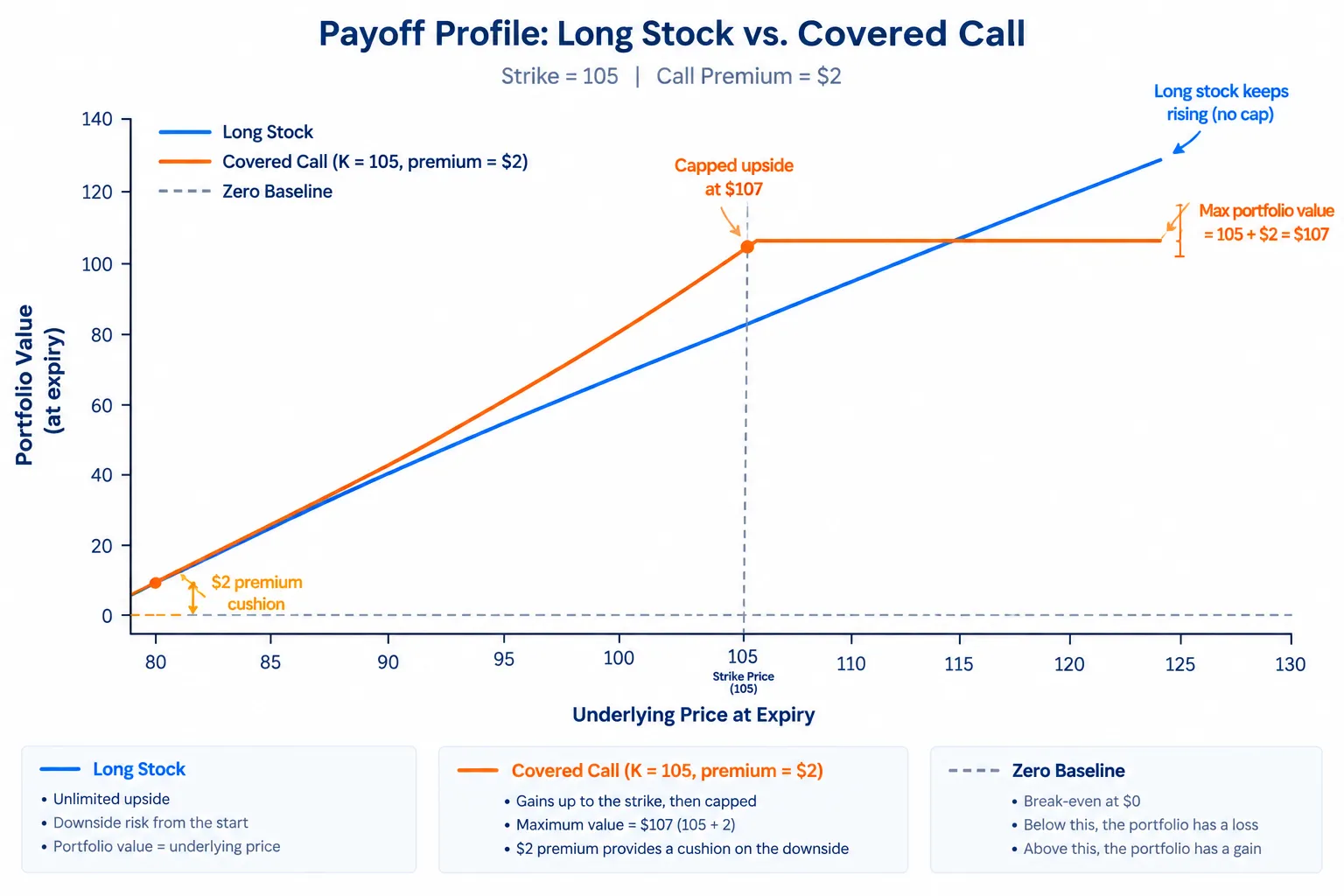
Illustrative payoff lines showing the covered call premium cushion and the upside cap at the option strike
Portfolio value at expiry | Same portfolio without calls | With the covered call |
|---|---|---|
$90 | $90 | $92 |
$100 | $100 | $102 |
$110 | $110 | $107 |
Source: illustrative example. Covered-call value = portfolio value + $2 premium, minus any gain above the $105 strike.
The table shows three outcomes. If the portfolio falls to $90, the $2 premium softens the loss but does not prevent it. If the portfolio is flat at $100, the fund keeps the $2 and finishes ahead of the uncovered portfolio. If the portfolio rises to $110, the fund's gain is capped at the $105 strike plus the $2 premium. It finishes at $107 and gives up $3.
That trade-off is the whole design. The fund swaps its largest gains for steady premium, which it can pass on as covered call ETF monthly distributions. In flat or mildly rising markets, that can work. In sharp rallies, the fund gives up gains above the strike. In sharp declines, it still falls.
Funds also differ in how they write the calls. Some sell index options, others use options-linked notes or write calls on a bond ETF, and these structures can produce different results. Index options, options on ETF shares and options-linked notes differ in mechanics and counterparty exposure, and expenses reduce returns in every case.
How do Nasdaq-100, bank and bond covered call ETFs compare?
Covered call ETFs share a method but hold very different assets. The underlying holding drives most of the risk, so the label "covered call" tells you less than the portfolio does.
Fund | What it holds | Call writing | Distributions |
|---|---|---|---|
QYLD (Global X Nasdaq 100 Covered Call ETF) | Nasdaq-100 stocks | Calls on the portfolio | Monthly |
QYLG | Nasdaq-100 stocks | Calls on approximately half the portfolio, per the issuer | |
ZWB (BMO Covered Call Canadian Banks ETF) | Canadian bank shares | Sells calls | Monthly |
TLTW (iShares TLT Premium Income+ ETF) | Exposure to the iShares 20+ Year Treasury Bond ETF | Writes covered calls | Monthly |
Source: issuer fund disclosures and fact sheets (Global X, BMO, iShares).
QYLD and QYLG: Nasdaq-100 covered call ETFs
A Nasdaq 100 covered call ETF such as QYLD holds Nasdaq-100 stocks and sells calls against them. QYLD lists a 0.60% total expense ratio. The underlying index can rise sharply, so this is the type of fund where a capped upside can matter most.
QYLG writes calls on approximately half the portfolio, per the issuer. That leaves the other half free to rise with the market. The design keeps more upside than a fund covering the whole portfolio, and it also collects less premium. Neither choice is better in the abstract. They are different trade-offs.
ZWB: Canadian banks
ZWB owns Canadian bank shares, sells calls and pays monthly, per BMO's fund fact sheet. The fund is listed in Canada, so a U.S. investor should check currency and account-type issues before buying.
TLTW: Treasury bonds
TLTW holds exposure to the iShares 20+ Year Treasury Bond ETF, writes covered calls and distributes monthly, per iShares. The underlying asset is long-dated Treasuries, so the main risk is interest rates. When long bond prices fall, the call premium offsets only a small part of the drop.
What does a high covered call ETF distribution rate actually measure?
A high dividend covered call ETF often shows a distribution rate that looks large next to ordinary stock dividends. That figure needs careful reading. Global X says so directly in the QYLD fund disclosures:
"The rate represents a single distribution from the fund and does not represent total return of the fund."
A distribution rate takes one payment and annualizes it. An issuer may publish a trailing 12-month distribution rate, a single recent payment annualized against NAV, and a 30-day SEC yield. Each answers a different question. Several other measures get confused with the distribution rate:
Measure | What it asks | What it does not establish |
|---|---|---|
Distribution rate | How much cash did the fund pay, annualized, as a share of price? | Total return, or whether the payout will continue |
30-day SEC yield | What was the fund's standardized recent net investment income under SEC rules? | The entire option-driven cash distribution |
NAV total return | What happened to the fund's value with distributions reinvested? | That a future spending rate is sustainable |
Tax characterization | Was a payment treated as ordinary income, capital gain or return of capital? | Whether the fund made or lost money economically |
Source: definitions; the distribution-rate wording follows Global X's QYLD disclosure.
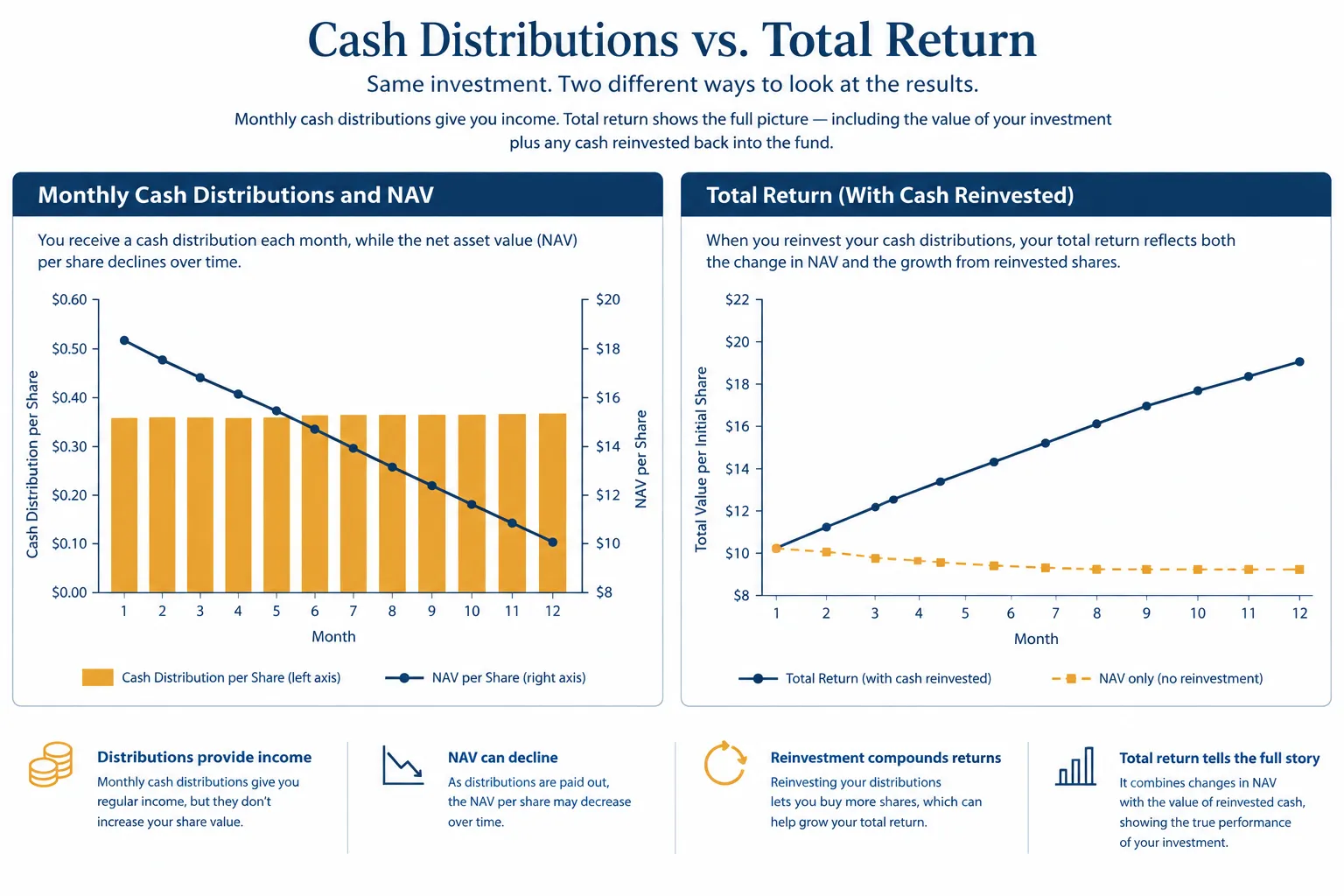
This distinction matters because covered call ETF income and total return can differ widely. A fund can pay a large monthly amount and still lose value if its share price falls by more than it distributes.
Example: $50,000 in a fund with a 12% distribution rate
Suppose a retiree puts $50,000 in a fund showing a 12% annualized distribution rate. That suggests $6,000 of annual cash. Now suppose the fund's total return for the year is 5%, which is $2,500 earned.
The retiree withdraws the $6,000, but the position earned only $2,500. The position ends the year at about $46,500, ignoring taxes and compounding. That is a $3,500 shortfall, and the principal that generates next year's income is smaller. The cash was real, but part of it came out of the account's own value.
So the question to ask is not "how much does it pay?" but "how much did the whole position earn after the payments?" For more on this, see YieldDesk's article on whether covered-call ETF income comes from income or principal.
If you rely on the payments for living expenses, plan for a lower after-tax payout than the fund currently shows. Keep money needed soon out of an equity call-writing position that could suffer a deep drawdown.
What risks do monthly payments not remove?
Monthly payments feel steady. The covered call ETF risks underneath are not.
Capped upside. In a strong rally, the fund gives up gains above the strike. At-the-money calls can surrender much of a sharp rally, while a partial overwrite or a higher strike retains more upside and changes the premium collected.
Downside stays. The premium cushions losses only slightly. A downturn can reduce your capital while you continue taking distributions, and if calls cap the rebound, recovery may take longer.
Variable payments. Premiums depend on volatility, strike and time to expiration, so the fund may pay monthly without paying the same amount each month.
Concentration. Nasdaq-100 stocks, banks and long-duration bonds react differently to shocks, and holding several high-paying ETFs does not ensure a diversified portfolio.
Counterparty and expenses. Options-linked notes add counterparty exposure, and expenses reduce returns in every structure.
Living expenses. If you rely on the payments for living expenses, plan for a lower after-tax payout than the fund currently shows, and keep money needed soon out of an equity call-writing position that could suffer a deep drawdown.
How are covered call ETF distributions taxed?
Covered call ETF taxes are less simple than the monthly deposit suggests. A single payment can combine several types of income, and the fund only finalizes how it is characterized after year-end. A monthly deposit is not necessarily a qualified dividend, so use the fund's final year-end tax characterization.
The part many investors miss is return of capital. When a distribution is classified as a return of capital, it is not treated as ordinary income when you receive it. Return of capital generally reduces your tax basis until it reaches zero. A lower basis means a larger taxable gain, or a smaller loss, when you eventually sell.
In practice, that means:
Return of capital defers tax rather than removing it.
Your cost basis can shrink year after year as these distributions accumulate.
The fund's year-end tax reporting, not the monthly payment notice, decides the final split.
The ROC tax label alone does not tell you whether the investment lost money. A high payout paired with a persistent drop in NAV is more concerning.
A tax-advantaged account changes when you pay tax, not the fund's investment risk. Tax treatment differs by account type, country and fund. Check the fund's year-end tax characterization and consult a tax professional about your own situation. YieldDesk's JEPI distribution and return-of-capital research shows how one widely held fund's payments break down.
How do you choose a covered call ETF? A practical checklist
Use these questions to compare funds on the same footing:
What does it hold? Nasdaq-100 stocks, bank shares and long Treasuries carry different risks.
How much of the portfolio do the calls cover? Full coverage caps more upside than partial coverage, as with QYLG.
What is the fee? QYLD lists a 0.60% total expense ratio. Compare that with similar funds.
Look at the range of monthly payments and the final year-end tax classification. The monthly amount can vary, and the fund's year-end tax reporting decides how it is characterized.
Decide whether you could hold through a falling share price if the cash payment also declined. Compare price change with distributions over several years, and ask whether the position still fits your plan if both fall.
YieldDesk tracks income-focused securities with screeners, payment calendars, portfolio monitoring and tax tools. You can compare a covered-call position with preferreds and baby bonds in an income portfolio, as well as BDCs. A screen helps narrow the choices; it cannot predict next month's payment. There is a free Starter plan, with no card required. Create a free account to start. Quotes on YieldDesk are delayed by 15 minutes.
FAQs
What is a high dividend covered call ETF?
A high dividend covered call ETF holds stocks or bonds, sells call options on them, and pays out the premium along with any dividends or interest as a high distribution rate. The rate looks large because it includes option income and can include return of capital. It is not the same as a dividend yield or a total return.
How do covered call ETFs make monthly income?
They sell call options on their holdings and collect a premium each time. The fund combines that premium with any dividends or interest from its holdings, then pays most of it out on a monthly schedule. Option premiums change with market conditions, so the monthly amount can vary.
Is covered call ETF income the same as dividend yield?
No. A dividend yield reflects dividends paid by the underlying holdings. Covered call ETF income also includes option premium, and the headline distribution rate annualizes a single payment. As Global X notes for QYLD, the rate "does not represent total return of the fund."
Why can a covered call ETF's share price fall while it pays monthly?
The fund keeps the downside of its holdings and gives up upside above the strike. If the holdings fall, the premium cushions only a small part of the loss. If the fund pays out more than it earns, the share price can drift lower even while monthly payments continue.
Are covered call ETF distributions return of capital?
It varies by fund and by year. Some distributions are fully or partly return of capital, and others are mostly income. The fund's final year-end tax characterization decides the split. When a distribution is a nondividend distribution, the IRS treats it as a reduction of your cost basis.
Conclusion
A covered call ETF trades upside for premium and pays it out, often monthly. The payments are real cash, but the distribution rate is not a return, the amount can change, and the share price can still fall. No fund guarantees income.
Look at what the fund holds, how much it covers, what it costs, how the distributions are taxed, and what the position earned after payments. That gives you a clearer picture than the rate alone.
This article is for information only and is not investment, tax or legal advice. Past distributions do not guarantee future income.
Library articles are general information about securities and markets. They are not advice on any security or on whether to buy or sell it. Disclosures
The preferred stocks list shows every public record with its price, coupon, call date and yield.
The preferred stocks listRelated articles
Best Tools to Check BDC Dividend Safety Before You Buy (2026)
YieldDesk · 9 min
How can I get notified automatically about SEC filings that affect the preferred stocks I own?
YieldDesk · 8 min
Yield on Cost Calculator: How to Work It Out by Hand
YieldDesk · 7 minOne issue, every Sunday.
Eight blocks of data, one chart, no commentary. Rates, the week's movers, listings and filings across preferred stocks, BDCs and covered-call ETFs.
Free · Sundays · unsubscribe at any time · addresses are never shared