Yield on Cost Calculator: How to Work It Out by Hand
Use this yield on cost calculator guide to work it out by hand: the formula, a worked stock example, splits, DRIP, and a real estate version.
YieldDesk7 min readPublished
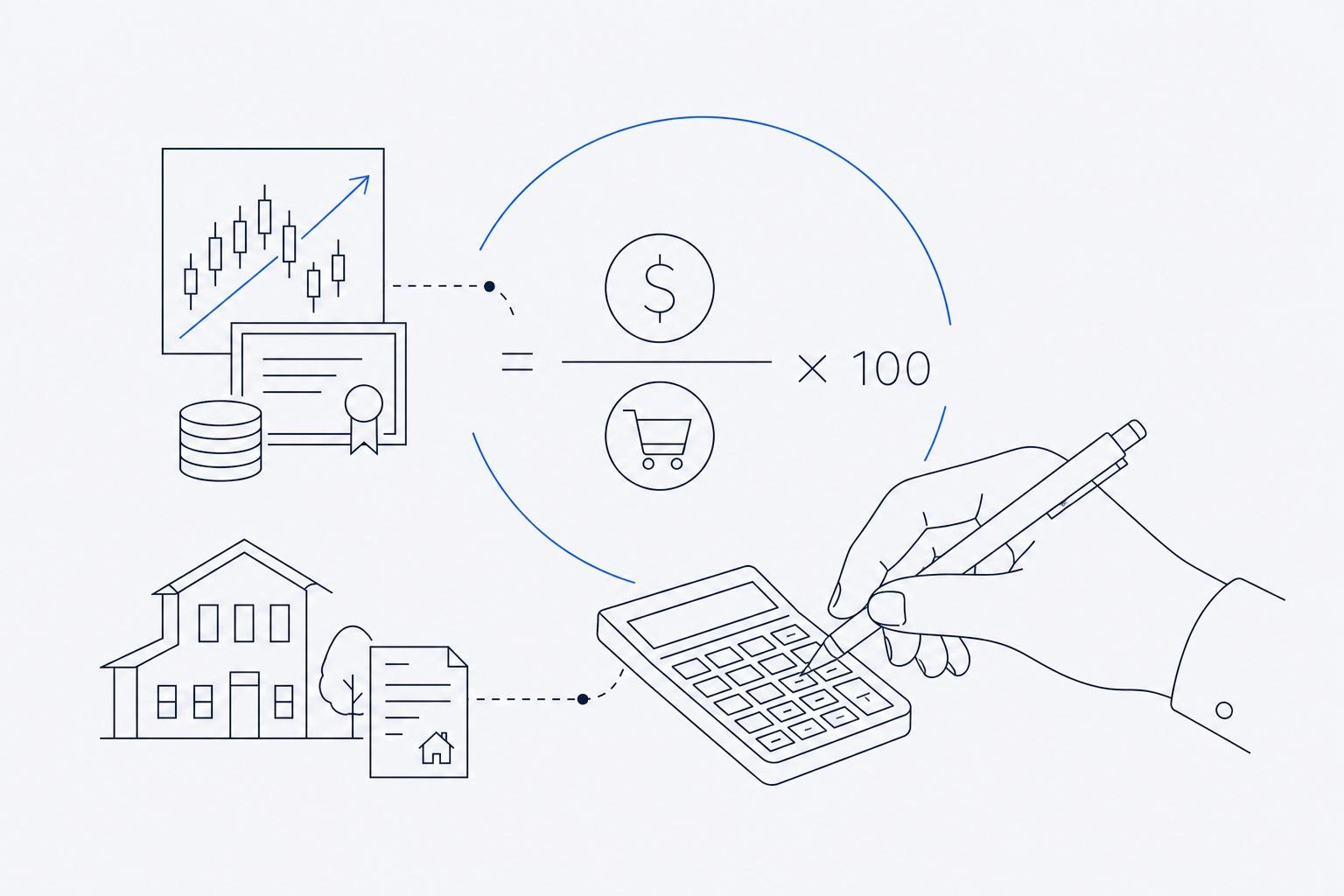
Yield on cost is the annual income a holding pays, divided by what you originally paid for it, times 100. The formula is: yield on cost = annual income ÷ original cost basis × 100. It measures the return on your own money, not on today's market price.
All example numbers below are illustrations, not market data.
What is yield on cost?
Yield on cost is the income a holding pays today, measured against the original cost of the position. For a dividend stock, it takes this year's dividend per share and divides it by the average price you paid per share. The result shows what your own purchases earn, whatever the share price is now.
That is the yield on cost meaning in practice: a measure tied to your cost basis, not to the market. Cost basis is what you paid, including any reinvested dividends. Because the yield on cost dividend figure rises as the payout grows while your cost stays fixed, the number often climbs for long-held stocks. For a short definition, see the yield on cost glossary entry.
What is the yield on cost formula?
The yield on cost formula is: yield on cost = current annual income ÷ original cost basis × 100. Three steps get you there for a stock:
Find the annual dividend currently paid per share.
Find your cost basis per share: total price paid divided by shares owned.
Divide the dividend by the cost basis and multiply by 100.
Yield on cost ignores what the position is worth today, so a high figure does not tell you the stock is a good buy now.
How do you use a yield on cost calculator step by step?
A yield on cost calculator, whether a spreadsheet or pen and paper, comes down to a weighted average and one division. The example uses illustrative numbers. You buy a dividend stock three times:
Purchase | Shares | Price | Cost |
|---|---|---|---|
First | 100 | $40 | $4,000 |
Second | 50 | $50 | $2,500 |
Third | 50 | $60 | $3,000 |
Total | 200 | $9,500 |
Weighted average cost = $9,500 ÷ 200 shares = $47.50 per share.
Suppose the stock now pays $3.00 per share a year. Yield on cost = $3.00 ÷ $47.50 × 100 = 6.32%. The same method works for any holding: add up the dollars spent, divide by total shares, then divide the annual dividend by that average.
A simple average of the three prices would give a wrong answer. Weight by shares.
How do splits and dividend reinvestment change your cost basis?
Splits change the share count and the per-share cost, but not your total cost. In a 2-for-1 split, your share count doubles and your per-share basis halves. The dividend per share halves too, so yield on cost stays the same.
Reinvested dividends (DRIP) add to your basis. Each reinvestment adds shares and dollars to your totals and shifts the average, so recompute after every purchase.
Yield on cost vs current yield: what is the difference?
Current yield divides by today's price; yield on cost divides by what you paid. Dividend yield and current yield are the same price-based measure: annual dividend divided by the current share price.
Yield on cost | Dividend yield (current yield) | |
|---|---|---|
Denominator | Your original cost basis | Current market price |
Changes when | Dividend or your purchases change | Dividend or price changes |
Answers | What am I earning on my money? | What would a new buyer earn? |
For the second column, see regular dividend yield.
Growth separates the two measures over time. GNG Research notes that a 4% starting yield on cost rises to about 7.9% if the dividend grows 7% a year for 10 years. According to Dividend Vision, Dividend Aristocrats, companies with at least 25 years of consecutive increases, have a median 10-year dividend growth rate of 6-9%. A new buyer in the same stock earns only the current yield, which is why the two figures can sit far apart.
Why can yield on cost mislead you?
Yield on cost answers a backward-looking question, and that makes it easy to misread. Four limits matter most.
It ignores today's price and opportunity cost. The figure divides by what you paid, not by what the position is worth now. If the shares have risen, the capital tied up in them could earn the current yield elsewhere, and yield on cost does not show that trade-off.
It flatters old purchases. A holding bought years ago at a low price and a growing dividend can show a high yield on cost, even though a buyer today would earn far less. The growth example above shows the effect: 4% becoming about 7.9% after 10 years of 7% dividend growth.
Inflation erodes it. A high yield on cost buys less each year. Compare dividend growth with price increases, not just with other yields. A payout that grows slower than inflation loses purchasing power.
A high figure does not mean a good buy now. Yield on cost describes your past decisions. It says nothing about whether the stock is fairly priced, whether earnings cover the dividend, or whether the payout will grow. For a new purchase, the current yield is the relevant number.
Does yield on cost matter for preferred stocks and baby bonds?
Less than it does for common stocks. Preferred stocks and baby bonds pay a fixed dividend, trade near par, and do not grow their dividend. For a preferred bought at par, yield on cost mostly equals the coupon on par, so it adds little beyond the stated rate.
The more useful measures are current yield, yield to call and yield to worst. The purchase price changes the picture. Buy below par and your yield on cost is higher than the coupon rate, but a call at par ends the income and returns less than the price implies if you paid above par. Buy above par and a call can produce a loss, so the yield you see on cost overstates what you will earn if the issuer redeems the security. Because call risk can cap the upside, check the call window before leaning on any yield figure. For how to assess this, read how to tell if a preferred stock will be called or redeemed.
Is yield on cost different for real estate?
Property developers use the term differently. In real estate, yield on cost is stabilized net operating income (NOI) divided by total project cost, times 100, and the result is compared with the market cap rate for similar finished buildings. It measures the return on a development budget, not on a dividend stock's purchase price, so the stock method above does not apply.
Keeping your yield on cost current over time
Update your cost basis and share count after every purchase, split, or reinvestment, then recalculate. A high yield on cost measures income, not taxes owed. Taxes depend on the account type and how the dividend is classified, so check that separately.
YieldDesk is a portfolio tracking tool that shows dividend income and payment calendars for income investors, and its Starter plan is free with no card required. For the wider method, read the income portfolio tracking guide.
FAQs
What is a good yield on cost?
There is no fixed benchmark. A good yield on cost depends on how long you have held the position and how fast the dividend has grown. A figure that looks high after many years of increases may simply reflect time and growth, while a high figure on a recent purchase is just the current yield.
What is the difference between yield on cost and current yield?
Yield on cost divides the annual dividend by what you paid. Current yield divides it by today's market price. Yield on cost shows what your own money earns, while current yield shows what a new buyer would earn. The two start equal at purchase and drift apart as the price and dividend change.
Is yield on cost the same as dividend yield?
No. Dividend yield uses the current share price as the denominator, so it matches current yield. Yield on cost uses your original cost basis. Both use the annual dividend as the numerator, but they answer different questions: what a new buyer earns versus what you earn on your own capital.
Is a high yield on cost taxed differently from a low one?
Generally no. Tax depends on the account type and the dividend's classification, such as qualified or ordinary, not on your yield on cost. Confirm your situation with a tax professional.
How does inflation change what a high yield on cost is really worth?
Inflation raises prices, so the same dollar income buys less over time. A high yield on cost that grows slower than inflation loses purchasing power. Compare dividend growth with price increases to see the real result.
Conclusion
Yield on cost is annual income divided by what you actually paid, using a weighted average basis when you buy in pieces. Adjust the basis for splits and reinvestment, and remember the figure says nothing about whether a holding is a good buy today. For fixed-dividend securities such as preferreds, it adds little beyond the coupon.
Next, list each purchase with its shares and price, compute your average basis, and divide your current annual dividend by it. Then compare the result with the current yield on the same holding to see how much of the figure comes from time and growth.
Library articles are general information about securities and markets. They are not advice on any security or on whether to buy or sell it. Disclosures
The preferred stocks list shows every public record with its price, coupon, call date and yield.
The preferred stocks listRelated articles

Best Tools to Check BDC Dividend Safety Before You Buy (2026)
YieldDesk · 9 min
How can I get notified automatically about SEC filings that affect the preferred stocks I own?
YieldDesk · 8 min
Covered Call ETF Guide: Income, Yields, Taxes and Risks
YieldDesk · 11 minOne issue, every Sunday.
Eight blocks of data, one chart, no commentary. Rates, the week's movers, listings and filings across preferred stocks, BDCs and covered-call ETFs.
Free · Sundays · unsubscribe at any time · addresses are never shared